Restore your sticking fire door: five practical adjustments that work
 Save
A fire door that sticks, drags or closes slowly puts your property at risk. When a fire door does not close properly, it cannot do its job – compartmentalising smoke and heat in an emergency. The problem is usually straightforward to fix, and you can address most common causes without professional help or losing your door's fire rating.
Why a fire door sticks in the first place
Fire doors stick for a handful of reasons, and identifying which one applies to yours is the first step. Doors stick when the frame has settled unevenly, when the latch bolt does not align with the strike plate, when hinges are loose or bent, or when the door itself has warped slightly over time.
A door that catches at the bottom usually means the frame has dropped at one corner. A door that sticks at the top tells you the opposite – the frame has risen. When the whole door feels tight as it swings, you are often dealing with loose hinges or a bent hinge pin.
Fire doors absorb moisture differently from standard doors because of their construction, which can cause minor warping. This is not a defect; it is normal wear. The good news is that most adjustments take under an hour.
Check where the door catches
Before you begin, work out exactly where the door binds. Open it fully and run your hand along the edge – you will feel a tight spot immediately. Mark it with a pencil so you do not lose track.
Watch the door as it closes without touching it. Does it swing freely until the last few inches? Does it stick throughout the swing? Does the latch bolt sit proud of the door edge (standing out instead of lying flush)? Each tells you something different about what needs adjusting.
Close the door slowly and feel whether it meets resistance early, mid-swing or just as the latch engages. A door that resists only during the final latch engagement usually needs the strike plate adjusted. A door that drags throughout the swing usually has a hinge or frame issue.
Adjust the hinges
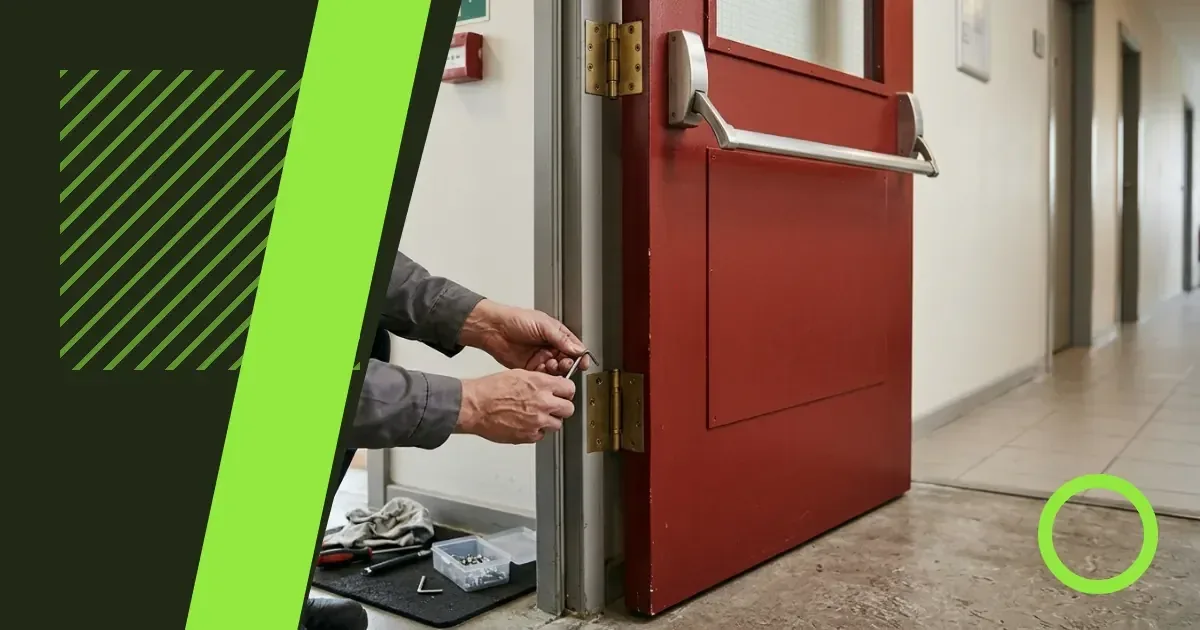
Loose hinges are the most common cause of sticking. Start here: use a screwdriver to tighten every screw on every hinge – both the screws that hold the hinge to the door and the screws that hold it to the frame. Tighten gently; these screws strip easily.
If tightening does not work, remove the centre screw from the middle hinge (the one closest to the centre of the door) and replace it with one that is slightly longer. This pulls the door closer to the frame. Start with a screw that is one-eighth of an inch longer than the original.
If the door still sticks at the bottom, the bottom hinge may be bent or the hinge pin may be warped. You can test this by removing the bottom hinge entirely and laying it on a flat surface – a bent hinge will rock. A bent hinge must be replaced; bending it back weakens it and risks fire-rating loss. Order a replacement that matches your existing hinges exactly.
Align the latch bolt and strike plate
If hinges are tight but the door still resists, the strike plate is probably out of alignment. The strike plate is the metal box on the door frame that the latch bolt slides into.
Close the door gently and look at where the latch bolt meets the strike plate. If the bolt sits above or below the opening in the strike plate, loosen the strike-plate screws (usually two or three) and move the plate up or down by a small amount – typically one-eighth of an inch – then retighten and test.
If the bolt sits to one side of the opening, loosen the screws and move the plate left or right instead. Make small adjustments; you may need to try several times. Once the bolt slides smoothly into the centre of the strike-plate opening, the door should close without resistance.
Address frame settlement
If hinges and strike plate are properly aligned but the door still drags, frame settlement is the likely cause. You will see this most often in older buildings or where subsidence has occurred.
Check whether the frame is square by measuring diagonally corner to corner – both diagonals should be equal. If they differ by more than a quarter-inch, the frame has settled unevenly. Small settlement is normal and fixable; large settlement (over half an inch) may require professional help.
For minor frame settlement, you can pack the hinge-side jamb with shims (thin wooden wedges). Open the door fully and wedge shims between the hinge side of the frame and the wall behind it until the door swings freely. Work from the bottom up, checking the door's swing as you go. Once the door closes smoothly, screw the shims in place so they do not shift.
When to replace rather than adjust
Some problems cannot be fixed with adjustment alone. If the door itself is warped – you can see a visible bow along its edge – replacement is the only option. A warped fire door cannot seal properly and will eventually fail a fire rating test.
If the frame is cracked, twisted or badly corroded, adjustment will not help. A compromised frame must be replaced to maintain your fire rating. Do not try to reinforce a damaged frame with filler or sealant; this is not recognised by building regulations.
A broken closer (the hydraulic device that pulls the door shut) cannot be fixed. Closers are designed to fail safely, and a broken one must be replaced with one of the same specification.
Maintain your fire door after adjustment
Once your door closes smoothly, keep it that way. Check it monthly – the latch should engage with a clear click, and the door should swing freely without dragging. Wipe hinges and the strike plate clean of dust; debris builds up and causes sticking again.
Do not oil a fire door. Oil attracts dust and can affect the seals. If hinges squeak, use a dry lubricant such as PTFE spray instead.
If you fit a hold-open device (an electromagnetic holder that props the door open during normal use and releases it on alarm), check that the door still closes properly once the device is installed. A hold-open device slightly alters door balance, and the door may need a small re-adjustment to latch smoothly.
Know what you cannot do
Never plane, sand or trim a fire door to make it fit better. Removing material from a fire door compromises its rating. If the door is too large for the frame after years of shrinkage in the opposite direction, the door must be replaced, not trimmed.
Never drill into a fire door except where the manufacturer marks as safe (usually for hardware such as handles). Fire doors are built with internal components – intumescent strips, smoke seals – that are destroyed if you drill in the wrong place.
Never change the closing speed of a fire-rated door closer. The closer is set to a specific speed to allow people to exit safely; slowing it down risks trapping someone inside, and speeding it up can injure someone.
| Where the door sticks | What to check first | How to fix it |
|---|---|---|
| At the bottom | Frame settlement or warping | Shim the hinge side of the frame; check for warping along the bottom edge |
| At the top | Frame settlement in the opposite direction | Shim the hinge side higher up; check frame is level |
| During the full swing | Loose hinges or bent hinge pins | Tighten all hinge screws; replace any bent hinges |
| Just as the latch engages | Strike plate misalignment | Loosen strike plate screws and move up, down, left or right as needed |
Step-by-step: adjusting a sticking fire door
- Identify where the door catches by running your hand along the edge and marking the tight spot with a pencil.
- Tighten all screws on all hinges – both at the door and at the frame – using a screwdriver.
- Close the door slowly and check whether it now swings freely; if not, move to the next step.
- Check strike-plate alignment by closing the door gently and observing where the latch bolt meets the opening; loosen strike-plate screws and move the plate left, right, up or down by a small amount if needed.
- Test the door again; if it still sticks and you suspect frame settlement, insert shims between the frame and wall on the hinge side and tighten them with screws.
- Retest and make fine adjustments until the door closes smoothly with a clear latch click.
Download PDF: Fire Door Adjustment Checklist PDF, 29 KB
Further reading
Frequently asked questions
Why does my fire door need to close properly if there is no fire?
A fire door closes to compartmentalise smoke and heat in an emergency, giving people time to escape and stopping fire spreading between rooms. If your door does not close, it cannot do this job – which is why it is a building regulation breach. A sticking door also affects day-to-day use and signals that something inside the door mechanism may have changed.
Can I sand or trim a fire door to make it fit better?
No. Fire doors are built with internal components – intumescent strips and smoke seals – that are destroyed if you remove material. Trimming a fire door also compromises its fire rating. If the door is too large for the frame, it must be replaced, not altered.
What should I do if adjustment does not fix the sticking?
If hinges are tight, the strike plate is aligned and the frame is level but the door still drags, the door itself may be warped, or the frame may have settled more than can be corrected by shimming. Significant frame damage or a warped door requires replacement to maintain your fire rating. Contact a surveyor or fire-door installer to assess whether your frame is repairable.